

Leyland greets the crowd at open Dambe arena in Katsina, January 2024. Photograph Kayode Oluwa
Dambe boxing looked like an action movie scene to me at first
I originally found out about the African sport of Dambe through YouTube. At the time, I was searching for a sport to create a documentary about. I knew that the sport I was going to choose had to have interesting ties with culture and history. When I first came across Dambe, I thought it was a scene straight out of an action movie. I remember thinking to myself that if I was ever able to take part in this sport, then the journey it would take me on would be incredible. I knew it would be an amazing experience to share Dambe with the rest of the world
I got in touch with and had a lot of meetings with the fight promoters; they had never had a European fighter before. I knew I was going to be the first white westerner to compete in Dambe, a traditional boxing-style sport that had been around for over a 1000 years. It was important that we approached this properly.
Different cities offered different experiences
I studied the culture of Nigeria and visited Lagos, Kano and Katsina. Those three places were like three different worlds. The climate was very different in all three cities, as were cultures and beliefs.
When I arrived in Lagos, the people in and around the city were not too interested in me –they would look at me and sometimes double take but that was about it – people were more interested in me in Kano, where it is quite rare to see a white man. Sometimes people would approach to ask for a blessing (money) or they would just watch me as I walked by.
In Katsina it was similar but more intense: people would ask me why I was there and were generally shocked to see me. At first, the fighters were shocked at my arrival and fascinated by me. The fighters were glad I was there and seemed thankful for my efforts to show Dambe to the rest of the world. The community seemed split in their opinions. Some people were happy I was there, like the fighters, whilst others were quite concerned that I was going to take something away from Dambe, which wasn’t my intention.
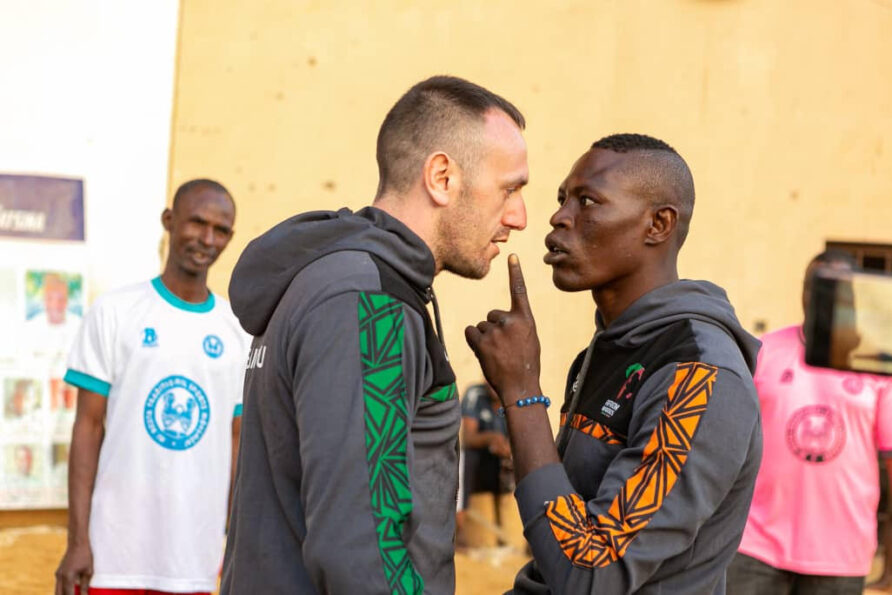
Luke Leyland confronts opponent Shagon Yellow ahead of their fight. Photograph Kayode Oluwa
A phone-in on live radio
We did many media meetings with different media groups. One of the meetings was a live phone-in on a TV station, and we were live on an Nigerian TV channel. The reporter started talking about my upcoming fight and then the phones started going crazy. The reporter would listen to questions in a different language and then ask me them in English.
People asked questions like “do you know the fighters have JuJu”.
There were some questions that the reporter seemed to shut down and when I looked at him he would just shake his head.I can only presume these were negative calls. Some phone calls would be fans of Dambe praying for me.
While I was answering questions, I kept hearing beeping. I asked what the beeps were and I was told every beep was someone trying to get through on the phone. The host showed me how many viewers had phoned up and there were over 380 people waiting. We were only there for 45 minutes so unfortunately, we could not speak to everybody.
The night before the fight I was inducted into a Dambe House. Dambe Houses represent certain parts of Nigeria and each house competes to see which house or team can achieve the highest number of wins. Being inducted to a Dambe house was a great honour, as I was the first non-African to be inducted. I was given my Dambe name which was ‘Dan Bature Kudawa’ which means ‘white man of house kudu’ – this would later be a fitting name for the documentary (you can watch the official trailer below).
The day of the fight had arrived!
Before I knew it, fight day was here and when I arrived at the open air theatre that was being used as the Dambe arena, there were thousands of people all waiting to get in. There were also the police and the army with guns controlling the crowd. You could hear the cheers and the roars of the crowd from outside.
I walked into the arena and got myself ready. I could see my opponent down a stone corridor, putting his Dambe rope on very tight. It was like the final part of a movie – backstage in the arena it was all stone – and it made me think of where Roman gladiators would stand before they went out to compete. The hallways were dark and cold but there was a very plesant sweet smell in the air from some of the ingredients used in Juju potions and practices.
The Rope Was Blessed with JuJu
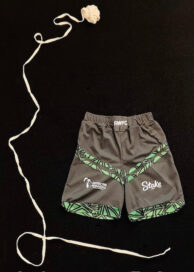
Traditional “Kara” rope hand binding, and Team Kudu shorts. Photograph Kayode Oluwa
A few days before the fight, one of the most powerful moments was witnessing the preparation of the kara — the rope tied around a fighter’s lead fist. This wasn’t just a physical process; it was deeply spiritual. The kara is often rubbed with special herbs, ashes, or oils, and in many cases, it’s blessed with juju — traditional spiritual practices believed to offer protection, strength, and supernatural aid in combat.
You could smell the potent mix of ingredients in the air: earthy, sweet, and slightly smoky. It created a heavy, almost mystical atmosphere. Watching my opponent tighten his kara, I could sense the centuries of tradition woven into every strand. The rope wasn’t just part of the sport — it was part of the soul of Dambe, infused with belief, ritual, and the unseen forces of juju.
They called my Dambe name and the fight started
Suddenly, the crowd was silent and my name, ‘Dan Bature Kudawa’, was called, signalling for me to come forward to the centre of the arena and into the sand. The fight began and my opponent, whose name was Shagon Yellow, moved through the sand like a shark through water. It was very difficult to move and he was very difficult to hit. 1000 years of history and ancestry in this fighting game was certainly showing through my opponent.

Shagon Yellow v Luke Leyland Dambe fight, Katsina, Jan 2024. Kayode Oluwa
After two rounds, the fight had come to an end through a stoppage, due to my knee and fist touching the floor which was not allowed. I wanted to continue but also had to respect the sport and the rules by taking defeat like a true Dambe combatant. After I had competed, the adulation from the fans was unbelievable. I had lost the fight but was treated like a winner. People wanted pictures and were chanting my name and I suddenly had fans all over Katsina, in Kano and even in the airport on my way home.
I understood that I had done something amazing for the sport and realised that even though I had lost the fight, I had won the hearts of the people.
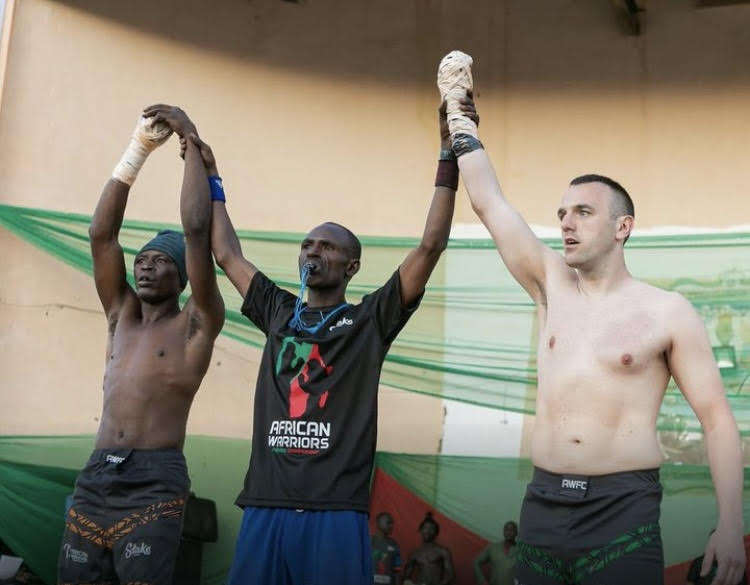
Opponent Shagon Yellow (L) and Leyland with fight Ref. Photograph Kayode Oluwa
Reflecting on my adventure while going home
On my journey home, I found myself reflecting on my adventure. I found Nigeria amazing. It was certainly a culture shock for me, especially places like Kano and definitely Katsina. I think about my time there even now, and I do miss the people of the North of Nigeria, they took me in after the fight and treated me like a winner.
The way of the people there is amazing and I realise sometimes that they do something that a lot of us in the west don’t, and that is appreciate the simple things. Not many people I saw in the north had mobiles and if they did, it wasn’t a smartphone.
Kids were out playing everywhere, for me it was like going back in time. I don’t mean that with any disrespect and I prefer their way of life. The way society is at the moment, especially in my community, is far removed from that. Appreciating the simple things is something most of my community misses, and definitely something I will be taking forward with me, as well as a story of a brilliant adventure that one day started in Africa.
Dan Bature Kudawa — Watch the Official Documentary Trailer
You can get the latest news on the Documentary and it’s full release date by following Luke Leyland at the related links found below.


