
 Written and illustrated by Jessica Hartshorn. Archive photographs and illustrations from the National Fencing Museum. May 2025
As an illustrator, I am passionate about design and have an appreciation for fashion and its ongoing evolution. Throughout my career, I have collaborated with various sporting museums to illustrate and learn about sporting attire. However, it was not until my daughter developed a love for Epee fencing that I became captivated by the distinctive sportswear linked to this unique sport.
Fencing, the elegant dance of swords, has long been associated with grace, skill, and precision. Over the centuries, the fashion in fencing has evolved, intertwining style with the ever-important aspect of safety. Let’s embark on a journey through the changing trends of fencing fashion, examining both male and female kits, safety measures, protection, and the fabrics that have adorned these skilled duelists.
The Early Days: Dashing and Daring
In the 16th and early 17th centuries, fencing was more a way for the European elite to learn how to defend themselves than a sport. The Fencing Museum provided various archives, revealing that early fencing books depicted swordsmen either naked, to show which muscles were used, or fashionably dressed.
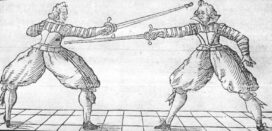
© National Fencing Museum
The attire of the time was as stylish as it was functional. Fencers in the UK donned doublets, tight-fitting jackets that allowed freedom of movement while also showcasing the wearer’s figure.
These doublets were shown for the first time illustrated in a manual in 1611. Made from luxurious fabrics like silk and velvet, these garments were often richly decorated with embroidery and lace.
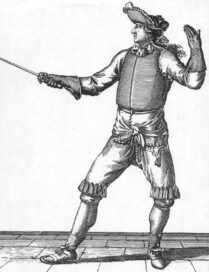
© National Fencing Museum
Men’s kits typically included knee-length breeches (trousers), stockings, and heeled shoes. Safety was a secondary concern, leading to an array of injuries among the fencers.
Philibert De La Touche in 1670 was the first to show a plastron (a protective padded layer to protect the chest) in an engraving (lying on the floor) which was the start of kit protecting the wearer.
18th to 19th Century: Evolution of Elegance
As fencing evolved into a regulated sport in the 18th century, the attire became more practical. The introduction of the fencing mask by the famous French fencer La Boëssière, in the late 18th century, marked a significant advancement in safety. The wire mask, initially made of iron, was a game-changer, offering protection without compromising visibility.

Henry Angelo by Mather Brown. Oil on canvas, circa 1790. NPG 5310 © National Portrait Gallery, London
The classic side-buttoning fencing jacket may have been introduced by Henry Angelo, who is shown wearing one around 1790 in a painting at the National Portrait Gallery.
In the second half of the 19th century, fencing became increasingly accepted as a sport for women. Female fencers adapted their attire to include more practical, yet still elegant, designs. Floral patterns covered their white linen jackets and silk-lined black skirts were recommended by The London Ladies’ Fencing Club.
Men’s and women’s fencing kits continued to mirror contemporary fashion but with a greater emphasis on safety. The light and flexible cotton fabric replaced the heavier materials of the past, providing better protection and comfort
20th Century: Modernisation and Uniformity
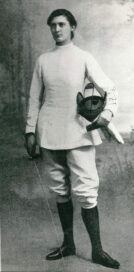
© National Fencing Museum
The 20th century brought significant changes to fencing fashion, driven by a focus on safety and standardisation. The traditional, individualistic styles gave way to uniform kits that ensured all fencers were equally protected
Men’s and women’s kits became more similar, though women’s uniforms retained a touch of grace with tailored fits. In the photos here, Toupie Lowther, a talented fencer in the early 20th Century wore a white embroidered tunic-style jacket with white breeches.
Early 20th century equipment suppliers offered many different glove styles and from Wilkinson Sword’s catalogue of 1913. Equipment suppliers offered many different styles of glove, outfit and weapon. Fencers could order jackets in different fabrics. Fencing jackets, now made from robust cotton and synthetic blends, offered better resistance to punctures and tears.
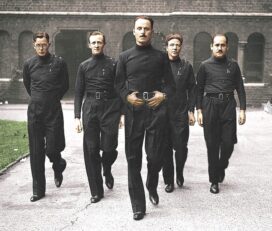
© National Fencing Museum
The development of Kevlar-reinforced fabrics in the late 20th century, provided an additional layer of protection. Breeches were designed to protect the legs while allowing maximum mobility, and the iconic fencing mask was further improved with advanced materials and designs.
Despite this progression fashion was even used as a political tool, such as when the politician and British fencer Sir Oswald Mosley modelled the black shirts of his fascist party as part of his kit.
In 1924, women started participating in the Olympic Games, wearing white jackets and black pleated skirts. However, there were concerns that the skirts posed a safety risk as the blades could get caught in them.
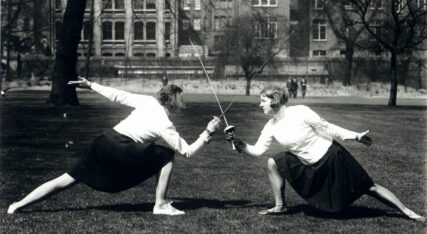
British champions Gwen Neligan (left) and Muriel Freeman (right) © National Fencing Museum
By the 1932 Olympics, the kit transformed again. Malcolm Fare from the National Fencing Museum explains:
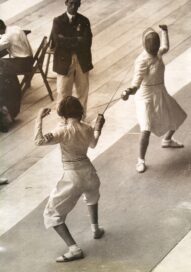
© National Fencing Museum
“Britain’s silver medallist Judy Guinness was one of the first women to wear breeches, which soon became the garment of choice for female fencers.
The lower edge of the target was bounded by a line drawn across the top of the hipbones and was indicated by a length of black piping sewn across the jacket.”
The women’s target was finally made the same as the men’s in 1964.
21st Century: The Blend of Fashion and Function
Today, fencing attire across the world reflects a perfect balance of fashion and function. Modern kits are sleek, lightweight, and designed with the latest technology to ensure the highest level of safety. Men’s and women’s kits are crafted from high-performance fabrics like Dyneema and Kevlar, offering unparalleled protection and durability.

British Youth champions with my daughter on the right © Jessica Hartshorn 2025
Both male and female fencers wear form-fitting jackets, breeches, and underplastrons (protective vests) to safeguard the chest. The fencing mask, now featuring advanced mesh and padding, provides excellent protection while maintaining visibility and breathability. Also, one sleek glove is worn on the blade hand to protect from hits.
Despite the focus on safety, contemporary fencing fashion has not lost its flair. Customisation options allow fencers to add personal touches to their kits, from embroidered initials to team logos, ensuring that style remains an integral part of the sport. Masks can now also display designs which are painted or sprayed onto the mesh, such as the Union Jack. As masks are painted on the outside, a design doesn’t impact the fencer’s vision. Colourful club socks also add a vibrant flash of colour, whilst also protecting the fencers shins.
Conclusion: The Evolution Continues
Fencing fashion has come a long way, from the ornate doublets and breeches of the past, to the high-tech, sleek kits of today. As the sport continues to evolve, so too will the attire, always balancing the timeless elegance of fencing with the paramount importance of safety and protection. For parents of fencers like me, navigating the world of blades and protective gear can be overwhelming but I hope my take on fencing fashion has boosted your confidence.
Whether you’re an aspiring fencer or seasonal pro, rest assured that you can look stylish and stay safe on the piste. En garde!
For more information about fencing history visit The National Fencing Museum website
 Other information:


