
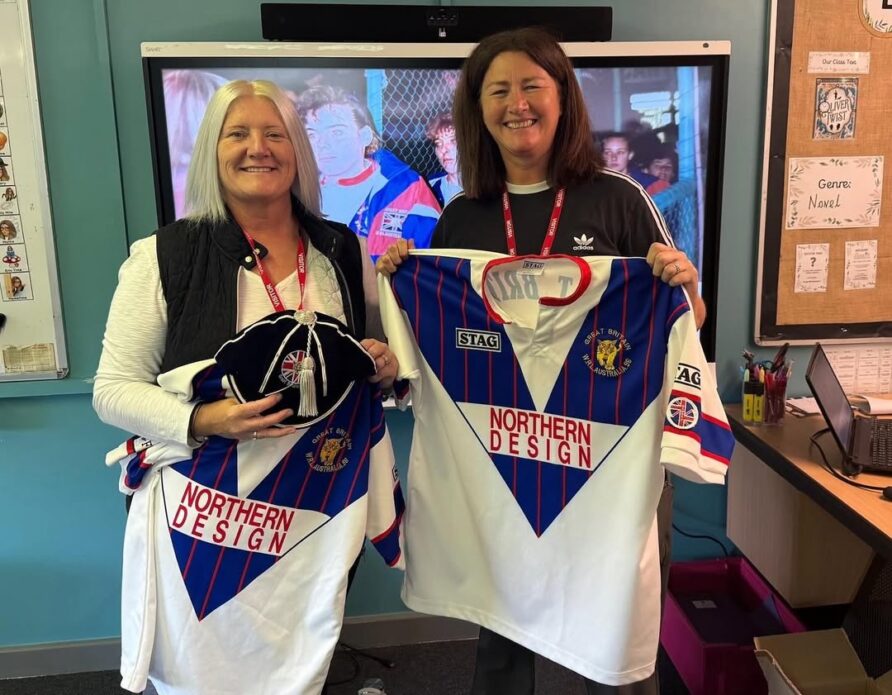
Joanna Carr-Will and Lucy Ferguson from the trailblazing 1996 Great Britain Lionesses Team have shared their story in Yorkshire Classrooms as part of the Pioneering Years project. Women In Rugby League/Literacy Kicks
This National Sporting Heritage Day, we at Women in Rugby League were delighted to show our appreciation and gratitude for all the help we have received to promote our great sport, most recently through our Pioneering Years Project and partnership with Literacy Kicks.
 Our aims are to celebrate the past and champion those who paved the way, to promote the modern game and share the continued growth, and inspire future generations of women and girls to get involved in rugby league. None of this would be possible without the support of our partners at Sporting Heritage.
During our Pioneering Years project, in which we aim to chart the history of women’s rugby league from the very beginnings of the league in the 1980s to the present day, we have been fortunate enough to have some genuine legends of the sport on our side.
The crowning achievement of the project so far has been the rightful induction of the 1996 Great Britain Lionesses team into the Rugby League Hall of Fame, alongside individual recognition for two superstars of that team, Jane Banks and Michelle Land.
However, the sport was built by women who for too long have been unsung heroes – those who started teams in places like Barrow-in-Furness, Warrington, and Wakefield and faced opposition to women playing rugby at all.
The modern game owes a debt of gratitude to the women who played in the first official women’s Challenge Cup final at Rochdale Mayfield in 1989, and those who travelled to France that same year as part of the first selected Great Britain women’s team. It is those contributions and more that we are honoured to celebrate.
In the present day, we have been delighted to offer former players the chance to reunite and reconnect with each other and the sport, as well as championing the modern game – the Betfred Women’s Super League, Challenge Cup finals at Wembley, and the huge growth of the modern international game, which peaked with a landmark fixture against Australia in Las Vegas in early 2025.
As part of the project, we seek to inspire the next generation of rugby league players by sharing the stories of the past with schoolchildren, thanks to our partners Literacy Kicks.
Thanks to generous Sporting Heritage funding, we have been able to go into schools and tell the story of those trailblazing women who overcame massive challenges – both financial and discriminatory – to tour Australia and win the Ashes. They remain the last British senior team to beat Australia in a Test series.
Alongside Literacy Kicks, we have been able to introduce that story to a new
generation of young people, and hopefully inspire them to take up sport themselves.
None of this would be possible without the help of Sporting Heritage and our partners, and for that we are forever grateful! Women in Rugby League director Julia Lee said:
“National Sporting Heritage Day is a great opportunity for us to take stock and see what we have achieved. Seeing the pioneers of women’s rugby league in the early days celebrated as heroes and finally getting their rightful recognition is so heartening, as it allows the players of today and tomorrow to understand how the sport has come so far.
We are so thankful to Sporting Heritage for giving us the opportunity to cheer so
loudly for women’s rugby league, and we hope to be able to carry the work on for
years to come – there is still so much to shout about.”
How did the 1996 GB Lionesses Team enjoy taking part in the Literacy Kicks project?
It was a delight to see the pupils at Plover Primary in Doncaster talking so positively about something I was involved with nearly 30 years ago. Then to compare it to today and show the changes in women’s rugby was really clever. The project was so well researched and presented. I watched the faces of the children, who were obviously engaged, listening to Gareth and watching footage of women play rugby league. The children contributed with interesting thoughts, ideas and questions. What a great way to promote this fabulous sport.
Jill Adams – 1996 Great Britain Lioness
Joining the Literacy Kicks projects to help bring our 1996 tour to life was such a privilege. Seeing the children come to life and engage with our story whilst recognising that there were similarities with themselves and how they could aspire to be the best they can be and maybe even represent their country one day was inspiring and an absolute joy to be part of.
Joanna Carr-Will – 1996 Great Britain Lioness
Visiting local schools with the Literacy Kicks project was an incredibly rewarding experience. The children were so engaged and curious, and it was a real privilege to share the story of the 1996 GB Women’s Rugby League team with them. Seeing how storytelling and sport can ignite imagination and confidence in young people was truly inspiring. I’m proud to have been a part of something that encourages the next generation to dream big and believe in their potential.
Lucy Ferguson – 1996 Great Britain Lioness
It has been a complete privilege for Literacy Kicks to be involved in Women in RL’s heritage project on the trailblazing 1996 Great Britain Women’s Rugby League team. Having such an inspirational story to take into primary school classrooms provided the perfect subject to engage children in writing, and to then be joined by members of the Lionesses team added an extra dimension to the sports journalism workshops. The way that Lucy, Jo and Jill could offer first hand insights into their 1996 experiences – from raising their own funds, to losing the first test before triumphing in the final two – was fantastic for the children in class. They certainly enjoyed trying on their playing shirts and caps as well! We’re thankful too for the support of the brilliant Sporting Heritage in funding this project.
Gareth Walker, Literacy Kicks


